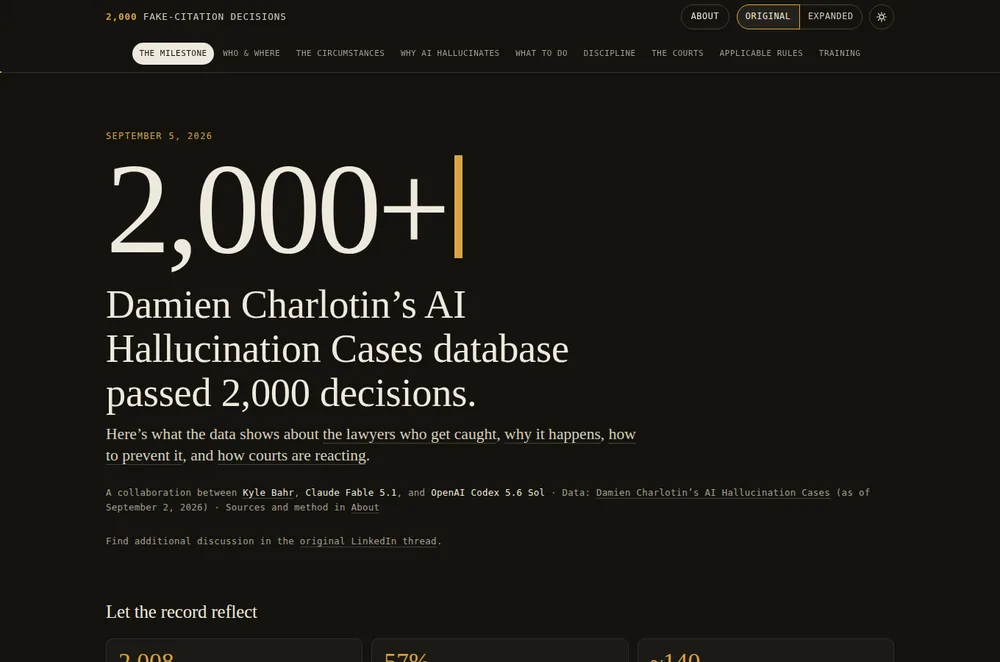
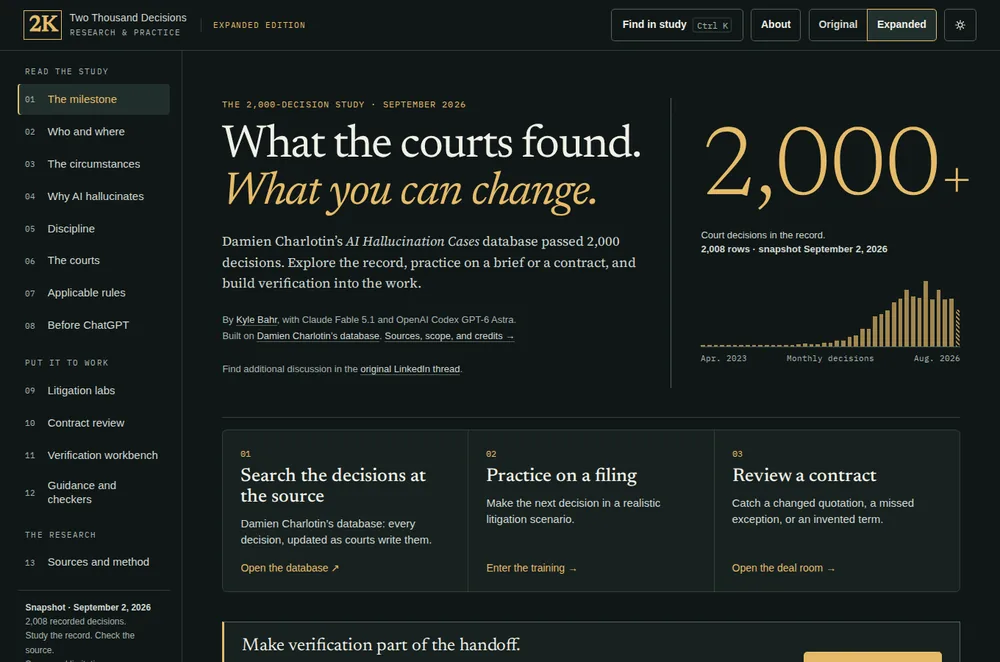
2,000 Fake-Citation Decisions
September 5, 2026
0

Damien Charlotin’s AI Hallucination Cases database passed 2,000 decisions.

Here’s what the data shows about the lawyers who get caught, why it happens, how to prevent it, and how courts are reacting.

Let the record reflect

2,008
decisions from 40 countries. 1,378 (69%) are American. A distant second is Canada (11%). Common-law jurisdictions dominate (90%).
57%
of decisions worldwide involve a pro se litigant (1,154). Lawyers or their staff account for 40% (809).
~140
court decisions handed down each month in 2026. The curve is shaping into a high plateau, rather than continued exponential growth. At present pace, we’ll reach 2,500 decisions in mid-December.
$2,500
median sanction amount for attorneys, which has remained quite steady. But large sanctions are becoming more frequent: awards of $25,000 or more went from one in the first half of 2025 to four in the second, then five in the first half of 2026.
$94,704
largest verified award in one order: the other side’s fees and costs, not a fine (Couvrette v. Wisnovsky, D. Or. 2026). Fee awards are where the big numbers are.
0
lawyers disbarred for fake citations, in any U.S. jurisdiction. Attorneys have had their licenses suspended; the longest was a year and a day (Colorado, 2023, ninety days served). Courts have also barred lawyers from appearing before them, for up to two years (N.D. Miss., 2026).
28%
of court orders aimed at lawyers (128 of 450) involved no invented case at all. The filings were still false: real cases misquoted, cited for holdings they do not contain, matched to the wrong reporter citation, or pinned to the wrong page, and in some a fabricated or misquoted statute or rule, or facts not in the record.
1 in 5
orders names the AI tool (86 of 450, 19%). Where one is named, ChatGPT leads; the orders almost never say whether it was the free or paid version.
47%
of private-practice lawyers caught were solo practitioners (184 of the 395 placed in a firm-size band).
Decisions per month, and the running total
Bars: decisions by the date the court issued them. Line: cumulative count, to 2,008. August 2026 is hatched because that month was still being filled in when the data was exported.
Source: the database as of Sept. 2, 2026, all countries. Milestones are the 1,000th, 1,500th, and 2,000th rows when sorted by decision date (Jan. 19, May 1, and Aug. 27, 2026).
The pace: time to each milestone
Milestones by decision date. The first five hundred took two and a half years; each five hundred since has taken three to four months.
The first 500 took 894 days; the next three blocks of 500 took 117, 102, and 118 (dates and yearly totals in the sources). Kyle Bahr’s 1,000-case dashboard (data through February 2026) forecast 2,000 for late October; it arrived about eight weeks early, because the plateau sits higher than the earlier trend assumed.
Where it goes next: 2,500 and 3,000
Four continuations of the recent monthly pace through June 2027. Arithmetic scenarios, not behavioral forecasts (base and rate windows in the sources).
ActualTrailing 3 months, 137/moTrailing 6 months, 141/moTrailing 12 months, 131/moLinear trend, 154/mo and rising
2,500: Dec. 5 to Dec. 25, 2026 across the four rates (mid-December on the six-month rate). 3,000: Mar. 6 to Apr. 20, 2027. Hover a dot for the rate and date. The public counter crosses each mark a few weeks after the decision-date curve does.

Dive into the data

Sources for this page
  1. Damien Charlotin, AI Hallucination Cases, damiencharlotin.com/hallucinations. Figures are from the database’s CSV download as it stood on Sept. 2, 2026 (2,008 rows): the export of Sept. 1 (2,006 rows), plus two rows added and eight rows edited since, each verified row by row against the live download on Sept. 3. Country count excludes one blank row and one ICSID tribunal row.
  2. Party counts: Pro se 1,154; Lawyer 792; Lawyer (mixed) 9; Government lawyer 7; Paralegal 1; Judge 24; Expert 15; Arbitrator 1; Unknown 5. “Lawyers or their staff” = 809 (Lawyer, mixed, government lawyer, paralegal). Common-law jurisdictions: 1,807 decisions from the United States, Canada, Australia, the United Kingdom, India, Singapore, New Zealand, Ireland, Hong Kong, Kenya, Uganda, Tanzania, Zimbabwe, Papua New Guinea, the Bahamas, and Trinidad and Tobago, counted by the database’s country field (which does not separate Quebec or Scotland); mixed systems such as Israel (57) and South Africa (6) are not counted.
  3. Median sanction: the 143 U.S. decisions tagged “Lawyer” with a stated dollar amount, median $2,500; by half-year, $1,500 (2025 H1, 17 amounts), $3,515 (2025 H2, 56), $2,712 (2026 H1, 57), $3,250 (July–August 2026, 14). Amounts of $25,000 or more by half-year: 1 (2025 H1), 4 (2025 H2), 5 (2026 H1), 2 (July–August 2026); amounts as recorded in the database; its largest, $110,204 in Couvrette v. Wisnovsky (D. Or.), combines a $15,500 penalty (Dec. 12, 2025) with a $94,704.38 award of fees and costs entered in a later order (Mar. 23, 2026), both read from the orders. Suspensions, disbarment, the 128 orders with no invented case (101 of them with at least one real-case defect: a real case misquoted, cited for something it does not hold, matched to the wrong reporter citation, or pinned to the wrong page; the rest a fabricated or misquoted statute or rule, facts not in the record, or another defect), the product counts, and the firm-size figures are explained on the Discipline, The circumstances, and About pages; the free-or-paid point: three of the 450 orders name a ChatGPT version or tier.
  4. Projections start from 2,008 on Sept. 2, 2026; the trailing rates are measured through July 2026 (August was still being filled in); the linear fit is ordinary least squares over August 2025–July 2026; dates use 30.44-day months. Monthly counts in 2026: 136, 132, 178, 127, 154, 127, 129 (mean 140), and 100 for an August still being filled in (154 in December 2025).
  5. Milestones by decision date: 500th Sept. 24, 2025; 1,000th Jan. 19, 2026; 1,500th May 1, 2026; 2,000th Aug. 27, 2026; first entry Apr. 14, 2023. Days per five hundred: 894, 117, 102, 118. Per year: 16 in 2023, 59 in 2024, 850 in 2025, 1,083 in January–August 2026. Prior forecast: the 1,000-case dashboard’s forecast array put the cumulative count at 1,870 for September and 2,022 for October 2026.
01 · Who and where

Two-thirds American, every U.S. state, majority pro se

Of 2,008 decisions, 1,378 (69%) are American and 1,154 (57%) involve pro se litigants. Decisions on lawyers account for 809 (40%) worldwide. We’ll focus on U.S. lawyers.

1,378
U.S. decisions (69%)
817
U.S. pro se (59%)
546
U.S. lawyer cases (40%)
934
Federal courts (68%)
442
State courts (32%)
214
Canada, second country (11% worldwide)
U.S. decisions by half-year: pro se and lawyer
Lawyers include prosecutors, government lawyers, a federal defender, paralegals, and mixed rows.
Pro seLawyer
The lawyer share is stable: 41% in 2025 H1 (40 of 97), 41% in 2025 H2 (172 of 422), 39% in 2026 H1 (245 of 621), 41% in July–August 2026 (72 of 177). Volume rose; the mix did not change.
Which courts
U.S. decisions by court types.
Court types checked against the orders themselves, not just the database’s labels (method in the sources).
Decisions by state
Hover a state. Compare all, lawyer, pro se, federal, and state decisions.
State assigned from the database’s court field (“S.D. New York,” “CA California,” “SC New York”), with ambiguous labels checked against the orders. New York’s “Supreme Court” is its trial court. Off the map: circuit courts, the GAO, the Court of Federal Claims, and other bodies without a home state (84 rows); Puerto Rico (5), Guam (2), and the Northern Mariana Islands (1).
The busiest courts
Decisions per U.S. court, pro se and lawyer cases. Trial courts in gold; appellate courts in blue.
Every spelling of one court counted together, and the districts or divisions of one appellate court counted as that court (the six Florida District Courts of Appeal as one, likewise the fourteen Texas Courts of Appeals).

The pro se majority, briefly

Sources for this page
  1. All counts from the database as of Sept. 2, 2026, U.S. rows (1,378). Court level and type from a rule-based reading of the free-text court field, checked against the linked order for every state-court label family: the database’s “SC” codes mean Superior Court (a trial court) in California, Connecticut, Delaware, Georgia, Massachusetts, Rhode Island, Vermont, and D.C., the Superior Court of Pennsylvania (an appellate court) in Pennsylvania, the Superior Court in New Jersey (one row, an Appellate Division decision), and Supreme Court in North Dakota, Nevada, Nebraska, Arkansas, Alabama, Hawaii, Oklahoma, Oregon, New Mexico, Colorado, and Iowa; one “SC New Hampshire” row with no case name or document is left unclassified; 17 rows were placed by reading the order or a companion decision where the label alone did not settle it (four “SC New York” rows are Appellate Division decisions; four district-court labels are bankruptcy court decisions; one row labeled “CC Minnesota” is a Mississippi circuit court order). Court types: trial 955, intermediate appellate 329, bankruptcy 33, administrative bodies 33, courts of last resort 24, unclassified 4. Federal 934, state 442, one tribal court, one arbitral forum. 84 rows have no home state. Top states: California 139, New York 123, Texas 84, Florida 66, Illinois 63, Michigan and Arizona 50 each.
  2. Busiest courts, with every label variant merged: S.D.N.Y. 50 (“S.D. New York” + “SDNY”); California Court of Appeal 40 (“CA California” and its six district variants plus one long-form label); New York Supreme Court 36 (“SC New York” + “Supreme Court, NY,” less the four Appellate Division decisions); E.D. Mich. 33; N.D. Ill., C.D. Cal., and W.D. Wash. 31 each; D. Ariz. and D. Nev. 29; N.D. Cal. 27; Texas Courts of Appeals 27 (seven label variants); Illinois Appellate Court 23 (six); D.N.J. 23; Florida District Courts of Appeal 22 (seven); S.D. Fla. and M.D. Fla. 21 each (both shown, tied at the cutoff). Next: the Arizona Court of Appeals, the California Superior Court, and the Government Accountability Office (bid protests), 20 each.
  3. Lawyer split: 360 federal, 186 state (of 546). Pro se monetary median: 38 U.S. pro se rows with a stated dollar amount, median $605.
  4. Appellate examples: Park v. Kim, 91 F.4th 610 (2d Cir. 2024); In re Nwaubani, No. 25-9517 (4th Cir. Mar. 11, 2026); Prososki v. Regan, 321 Neb. 38 (2026); Whiting v. City of Athens, 170 F.4th 455 (6th Cir. 2026); Lnu v. Blanche, No. 24-4790 (9th Cir. June 3, 2026); Noland v. Land of the Free, L.P., 114 Cal. App. 5th 426 (2025).
  5. Largest 2026 amounts against lawyers from state courts: Kleyman Law Group v. Kaloidis (N.Y. Sup. Ct.) $46,511; Ibach v. Stewart (Ala.) $17,200; Scott v. Illinois Human Rights Comm’n (Ill. App. Ct.) $15,000 — three of the ten largest, as recorded in the database.
  6. Map outlines: the us-atlas project’s 1:10m state boundaries (from the U.S. Census Bureau), Albers USA projection, simplified for this page.
02 · The circumstances

What 450 court orders say about U.S. lawyers

Of the 420 lawyers identified, 37 appear in multiple orders — one lawyer appears in five.

The cautionary tale’s eight traits
A roundup of this page’s statistics, illustrating the most prevalent circumstances underlying a lawyer’s submission of a fabricated citation. The way to reduce risks: verify all cited cases before filing.
Who generated the fake citation
As found by the court. “Unknown or denied” means the order does not say, usually because the lawyer never explained.
450 orders on lawyers. Signing lawyer 187; unknown or denied 217; client 10; law clerk, intern, or student 9; paralegal or staff 9; associate 7; co-counsel or local counsel 6; contract lawyer 5.
How AI was used
An order can record multiple types of AI use.
Research to find authority leads (174 orders). Editing or formatting citations appears in 8 orders and checking the AI’s own work in 12: the mutation cases, where a correct draft came back wrong.
What the lawyer said when caught
Explanations recorded in the order; a decision can carry more than one. Percentages are of all 450.

In the lawyers’ own words

“I didn’t know AI could do that” appears in 22 of 450 orders (5%). Counting each decision once, the ignorance family — didn’t know, thought it was a search engine, first time using AI — covers 35 (8%). Four of them:

“I did not fully appreciate that such tools can generate inaccurate or nonexistent citations unless each authority is independently verified through reliable legal research sources.”Lawyer’s declaration, quoted in Capital Standard, LLC v. U.S. Bank Nat’l Ass’n (Fla. 2d DCA Aug. 21, 2026)
“[T]he errors were unintentional and resulted from an inadequate verification process that confirmed only the existence of the cited cases, rather than the accuracy of the quotations, pin cites, parentheticals, and legal propositions attributed to those authorities.”Barteca Holdings LLC v. Tacobarn (D. Conn. Aug. 4, 2026), recording counsel’s explanation
“[S]he was unaware that AI could produce hallucinated cases and explained that she did not even know what a hallucinated case was.”Withers v. City of Aberdeen (N.D. Miss. June 8, 2026), describing an explanation the court found “insufficient and incredulous”
She “understood that ChatGPT was capable of what we have come to call hallucinations,” but “did not understand it could manufacture legal citations with fictitious names and ‘publication information.’”Jordan v. Chicago Housing Authority (Cir. Ct. Cook County, Ill. Dec. 5, 2025), describing a law-firm partner’s explanation
Who found the problem
What the court believed
How the lawyer handled being caught, according to 265 orders.
Eighty of 265 orders (30%) record a denial or a doubling down.
What was actually false
Coded from the orders; a decision can involve more than one kind.
Of the 450, 92 (20%) involved only nonexistent cases. In 128 (28%) no case was invented and the filing was still false: 101 of them carry at least one real-case defect (a real case misquoted, cited for a holding it does not reach, matched to the wrong reporter citation, or pinned to the wrong page); the rest involved a fabricated or misquoted statute or rule, facts not in the record, or another defect. Checking only whether the cited cases exist would not have cleared any of the 128.
What courts weighed
Aggravating and mitigating factors the orders name; a decision can carry several. Percentages are of all 450.
AggravatingMitigating

Four takeaways

Sources and method for this page
  1. Coverage: of the 546 U.S. rows tagged to a lawyer or a lawyer’s staff, 449 are in the coded set (the 450th comes from a row tagged to a judge or expert in which the court found a lawyer had used AI). The 97 not in it: 73 rows with no retrievable court document (59 link to press or a blog, 14 to nothing), 2 added to the database after the coding was done on Sept. 1–2 (one of them a party’s motion rather than a court order), 12 in which the order or the docket shows the filer was pro se (three of them found on the dockets after the orders were coded and recoded on September 2, 2026), 8 in which the user could not be determined, one whose linked document was a different case, and one unreadable. In pipeline terms: 560 U.S. rows tagged lawyer, prosecutor, government lawyer, federal defender, paralegal, judge, expert, or arbitrator; 483 with a court document hosted by the database, 481 of them downloaded by Sept. 1; 479 converted to text; 477 usable; 450 orders on lawyers after reading. Reading was done by Claude (Sonnet) under a written codebook, one pass per order, with no second coder and no agreement measurement. Every verbatim quotation the coder produced was checked mechanically against the order text after reducing both to letters only (1,565 of 1,586 matched; the 21 that did not are not used); that check establishes the words, not the coder’s reading of them.
  2. Firm-size research: conducted by OpenAI Codex 5.6 Sol on Sept. 2, 2026 over the 453 orders then coded (recomputed here for the 450 after three rows were recoded as pro se on the strength of the same docket work). Unit: one responsible lawyer in one decision; a lawyer counted only where the record tied that person to the defective filing (user, drafter, signer, show-cause target, or sanctioned person), never from an appearance alone. Firm size at the filing date where a source allowed it, otherwise at the decision date, in whole-firm counts; evidence in order of preference: contemporaneous filings, official firm and government pages, bar records, and archived pages; current pages only with a time caveat; directories last. Confidence across the 525 lawyer-decision records after the recode: 174 high, 267 medium, 24 low, 60 unresolved. The workbook and its 44 preserved source files are kept with the project and are not published because they name lawyers and small firms. Names consolidated on Sept. 3, 2026: the 434 name forms in the research resolve to 420 people after 14 pairs were matched by bar registration number, firm, and case (a shared surname, firm, or case alone was not treated as a match). Repeat lawyers are counted from the same roster: 37 of 420 in two or more of the 450 orders (one in five, one in four, three in three), of whom 13 appear twice only because one case produced two orders. One repeat lawyer’s firm is counted at 11–99 lawyers for both of her orders on the basis of an 11–20-member entry in the state bar directory, reported by the lawyer herself and last updated five months after the earlier order; the later order recounts a 2025 workflow with a supervising attorney on staff, which rules out a solo practice.
  3. Years since bar admission: researched by OpenAI Codex 5.6 Sol on Sept. 3, 2026 for the same 420 lawyers. The measure is the earliest verified admission we found, taken from official bar records (138 lawyers), official court or government sources (21), official firm or employer biographies (32), Martindale, Avvo, Justia, Lawyers.com, or another structured directory (196), and a court decision or other public report (7); no year was inferred from a law-school graduation year, a bar number, an age, a first appearance, or a firm’s founding date. Exact admission dates for 110 lawyers (completed years at the order date); the year only for 284 (order year minus admission year, accurate to within a year); 26 unresolved (a court-assigned pseudonym, a known license without a public date, an earlier foreign or territorial license without a date, or a directory behind a login). Confidence: 153 high, 231 medium, 10 low. Measured at the date of the first of the 450 orders against each lawyer, which can slightly overstate experience at the date of the defective filing. Bands: 0–1 years 4; 2–4 17; 5–9 44; 10–19 116; 20–29 103; 30 or more 110. The table names lawyers and is not published.
  4. Who generated the citation: signing lawyer 187; associate 7; paralegal or staff 9; law clerk, intern, or student 9; contract lawyer 5; co-counsel or local counsel 6; client 10; unknown or denied 217. How used: research 174; drafting portions 121; entire document 62; editing or formatting citations 8; checking own work 12; summarizing the record 6; not stated 193.
  5. Explanations (a decision can carry several): none recorded 179; admitted and apologized 138; delegated and did not check 67; typo or formatting 50; denied using AI 44; blamed another person 44; verified some citations 32; personal hardship 32; time pressure 27; blamed software 23; did not know AI fabricates 22; trusted a legal-specific or paid tool 22; first time using AI 15; workload 14; thought it was a search engine or database 9; other 54.
  6. Candor (265 recorded): admitted after the court raised it 162; admitted, timing not stated 1; admitted at once or self-disclosed 22; denied then admitted 26; denied throughout 17; doubled down with more bad citations 37. Side: plaintiff 226, appellant 67, petitioner 33; defense 78, respondent 13, appellee 9; criminal defense 10; prosecution 1; other 10; unknown 3. Firm size not stated 379; solo 44; two to ten 10; government 8; 100+ 6; in-house 2; mid-sized 1.
  7. Capital Standard, LLC v. U.S. Bank Nat’l Ass’n (Fla. 2d DCA Aug. 21, 2026); Barteca Holdings LLC v. Tacobarn (D. Conn. Aug. 4, 2026); Wilkes v. Canyons Sch. Dist. (D. Utah May 4, 2026); Withers v. City of Aberdeen (N.D. Miss. June 8, 2026). Repeat conduct: LiveVideo.AI Corp. v. Redstone (S.D.N.Y. June 9, 2026) (“[Counsel] is again referred to the Grievance Committee of this District”); Withers, above (noting In re Wise (Bankr. W.D. La. Apr. 9, 2026)); Coomer v. Lindell, No. 1:22-cv-01129 (D. Colo.), orders of July 7, 2025 and May 7, 2026 and second show-cause order of Mar. 25, 2026, as recorded in the docket text. Large-firm examples: Lacey v. State Farm Gen. Ins. Co., No. 2:24-cv-05205 (C.D. Cal. May 6, 2025); Johnson v. Dunn, 792 F. Supp. 3d 1241 (N.D. Ala. 2025); Wadsworth v. Walmart Inc., 348 F.R.D. 489 (D. Wyo. 2025); CalMatters (Aug. 18, 2026) on the State Farm matter; Volokh Conspiracy (Apr. 21, 2026) reproducing Sullivan & Cromwell’s disclosure letter (a voluntary disclosure, not a sanction).
03 · Why AI hallucinates

A language model, by itself, is not looking anything up

A language model predicts text; it does not verify citations. Retrieval, browsing, and citator links do not fully solve the issue. You must verify.

Shape
Name v. name, volume, reporter, page (court, year). The model knows the form perfectly. It does not reliably know the facts that fill it.
Rare facts
OpenAI’s own explanation: “[A]rbitrary low-frequency facts, like a pet’s birthday, cannot be predicted from patterns alone and hence lead to hallucinations.” A volume-and-page citation is that kind of fact.
Incentives
Models “hallucinate because the training and evaluation procedures reward guessing over acknowledging uncertainty,” in the words of Kalai, Nachum, Vempala, and Zhang (2025), the paper behind OpenAI’s explanation. A test that scores a blank as zero teaches the student to guess.
Newer ≠ fixed
Across eight generations of ChatGPT models, a Princeton team found that “hallucination rates are no longer consistently decreasing across model generations.”
Measured hallucination rates, with their definitions attached
The two Stanford RegLab studies (2024, 2025) tested different products, tasks, and definitions; their percentages are not directly comparable. Ranges are across the products each study tested.
2024: general-purpose chatbots asked “a direct, verifable [sic] question about a randomly selected federal court case,” 58% (GPT-4) to 88% (Llama 2). 2025: legal research platforms built on retrieval (Lexis+ AI, Westlaw AI-Assisted Research, Ask Practical Law AI), 17% to 33%, counting a response as hallucinated if “incorrect or misgrounded.” The second study’s own summary: “RAG systems, however, are no panacea.”
What the courts found, by type
All 2,008 decisions; a decision can involve more than one type. Categories are the database’s own.
Of the 1,905 decisions with an itemized finding, 239 (one in eight) involve no fabricated authority at all: every source was real, and the filing was still false. (103 decisions carry no itemized entry.) Among the 450 orders on lawyers, 28% had no invented case.

The mutation problem

A check that asks only whether the case exists catches one kind of error. The Princeton taxonomy of citation hallucinations, built from actual filings, has five categories, and an existence check catches only one of them: the case that does not exist. The other four survive it: a name and a reporter citation that “refer to two different real cases,” a page that “does not support the quoted language,” a quotation that “does not appear in the cited case,” and a real case that “does not support the proposition.” In 32 of the 450 orders on lawyers (7%), the lawyer told the court that some of the citations had been checked; the rest had not.

In Concord Music Group v. Anthropic (N.D. Cal. May 23, 2025), a lawyer had the right article and the right link and asked Claude to put the citation in proper form. Back came the right journal and year with “a fictitious article name with inaccurate authors (who have never worked together).” The AI’s process transformed the citation from correct to incorrect, and nobody noticed until it was filed. “That is a plain and simple AI hallucination,” the magistrate judge wrote, and yet “the underlying article exists, was properly linked to and was located by a human being using Google search.”

What the lawyer had
Owen McGrath & Kevin Burke, Binomial Confidence Intervals for Rare Events: Importance of Defining Margin of Error Relative to Magnitude of Proportion, 78 American Statistician 437 (2024), https://www.tandfonline.com/doi/full/10.1080/00031305.2024.2350445

A real article, found by a person using a search engine, with a working link.
What the model returned when asked to “properly format” it
Julien Dutant & Julia Staffel, A Statistician’s Guide to Making Sound Inferences from Noisy Data, 78 American Statistician 437, 437–449 (2024), https://www.tandfonline.com/doi/full/10.1080/00031305.2024.2350445

As filed in footnote 3 of the declaration (ECF No. 341-2). The journal, volume, page, year, and link were right. The title and the authors were invented.

Verify every citation after the final AI-assisted pass, including editing and formatting.

Legal research tools still require review

Sources for this page
  1. OpenAI, Why language models hallucinate (Sept. 5, 2025), openai.com; Adam Tauman Kalai, Ofir Nachum, Santosh S. Vempala & Edwin Zhang, Why Language Models Hallucinate, arXiv:2509.04664 (Sept. 4, 2025) (abstract). The paper’s examples are dissertation titles and birthdays; the application to citations is ours.
  2. Matthew Dahl, Varun Magesh, Mirac Suzgun & Daniel E. Ho, Large Legal Fictions: Profiling Legal Hallucinations in Large Language Models, 16 J. Legal Analysis 64 (2024) (“hallucinate between 58% (ChatGPT 4) and 88% (Llama 2) of the time”; the misspelling “verifable” is in the published text). Varun Magesh, Faiz Surani, Matthew Dahl, Mirac Suzgun, Christopher D. Manning & Daniel E. Ho, Hallucination-Free? Assessing the Reliability of Leading AI Legal Research Tools, 22 J. Empirical Legal Stud. 216 (2025) (“each hallucinate between 17% and 33% of the time”; “misgrounded” means “key factual propositions are cited but misinterpret the source or reference an inapplicable source”; “RAG systems, however, are no panacea”); preprint at law.stanford.edu.
  3. Sijia Chen, Hang Yin & Shunfan Zhou, LegalCiteBench: Evaluating Citation Reliability in Legal Language Models, arXiv:2605.10186 (May 11, 2026) (closed-book setting). Patty Liu, Dominik Stammbach & Peter Henderson, Who Checks the Citations? Benchmarking Legal Hallucination Detection, arXiv:2606.21155 (v2, Aug. 6, 2026), arxiv.org (92 legal drafting prompts across eight model generations; § 3, taxonomy). A preprint, not yet peer reviewed.
  4. Database as of Sept. 2, 2026, “Hallucination Items” field: “Fabricated” in 1,666 decisions; “Misrepresented” 837; “False Quotes” 544; “Outdated Advice” 33; 239 decisions carry no Fabricated entry; 103 carry no itemized entry. Subcategories: Case Law 1,806; Legal Norm (statutes, rules, regulations) 232; Exhibits & Submissions 144; Doctrinal Work 44; Other 43; Overturned Case Law 17; Repealed Law 16. Share of the coded orders on lawyers with no invented case: 128 of 450.
  5. Concord Music Grp., Inc. v. Anthropic PBC, No. 5:24-cv-03811-EKL (SVK) (N.D. Cal.): the citation as filed, ECF No. 341-2 at 3 n.3 (Apr. 30, 2025); counsel’s explanation of the formatting request and the manual check that missed it, ECF No. 371 ¶¶ 3–8 (May 15, 2025), which identifies the real article; the order, 2025 WL 1482734, ECF No. 377 (May 23, 2025) (van Keulen, M.J.). The real authors are Owen McGrath and Kevin Burke; the two named in the filed citation have never written together, as the order notes. Parker v. Costco Wholesale Corp., No. C25-0519-SKV (W.D. Wash. Nov. 7, 2025) (Vaughan, M.J.); Eugene Volokh, Volokh Conspiracy (Feb. 14, 2026) (the district judge’s referral to the state bar). TOV Realty, LLC v. Suarez, Nos. SC 21183, SC 21184 (Conn. July 31, 2026) (per curiam).
  6. Vendor language: LexisNexis launched Lexis+ AI (press release, Oct. 25, 2023) under a headline promising “Hallucination-Free Linked Legal Citations,” while the body said the product “minimizes the risk of invented content”; Zach Warren, Thomson Reuters Institute (Aug. 18, 2025), thomsonreuters.com (“GenAI hallucinations are still pervasive in legal filings, but better lawyering is the cure”); Anthropic, Usage Policy (effective Sept. 15, 2025), anthropic.com/legal/aup (legal work listed as a high-risk use: “[A] qualified professional in that field must review the content or decision prior to dissemination or finalization”). Closed-book benchmark: LegalCiteBench (May 2026) tested 21 models producing exact citations with no database to look in and found that “even the strongest models score below 7/100 on citation retrieval and completion.” This site was built with Claude models; the Concord example and the usage-policy quotation are reported as the record has them.
04 · What to do

Use the tools. Verify the filing.

The recurring failure is filing work nobody checked. Three steps catch it. The rest of this page is what those steps mean for each role, and where the citation checkers fit.

The check, in three steps

  1. Confirm the authority exists. Find it on CourtListener, Google Scholar, the court’s own website, or a subscription service, under the citation given.
  2. Compare the quotations and pincites. Every quoted phrase must appear on the page cited; every pincite must land on the words it stands for.
  3. Read for the proposition and the treatment. The case must hold what the filing says it holds and still be good law. No checker replaces this step.
Three simple words:Check 👏 Your 👏 Cites! 👏

By role

Open yours.

Junior lawyers

You will be handed AI-assisted work, and you will produce it. Treat every citation as unverified until you have opened the source and read the cited pages.

  • Open the case. Find the quoted words on the page cited. Read far enough to know the proposition survives the next paragraph.
  • Keep the transcript when you use a tool; courts have asked for it.
  • If a draft comes down with citations you cannot find, say so before it is filed. Lacey and Johnson v. Dunn both had people who could have.
  • Never ask the model that drafted the brief to check the brief. New Mexico’s ethics committee says why: it “can be misled by [its] own prior hallucination.”

Signing lawyers

Signing lawyers remain responsible even when they did not draft the filing or know AI was used. The signing lawyers in Wadsworth v. Walmart and Johnson v. Dunn did not know AI had been used; they were sanctioned for not checking.

  • Build one step into every filing: the signer, or someone the signer names, opens every citation.
  • Treat a research platform’s AI output like a summer associate’s memo: useful, fast, and yours once you sign.
  • If you learn of an error after filing, correct it before the court finds it. Lack of candor or delay in admitting was the aggravating factor courts noted most often (144 of 450 orders, 32%).

Senior attorneys: partners, general counsel, chief public defenders, U.S. attorneys

Rules 5.1 and 5.3 are the operative provisions, and Formal Opinion 512 says what “reasonable efforts” look like: clear policies, training that covers “the capabilities and limitations of the tools,” and supervision that actually checks.

  • A verification checklist attached to every filing, signed by a named person.
  • A rule that any document that touched a generative model — research, drafting, editing, formatting — gets a cite-check by someone who did not draft it.
  • A gate before any draft goes into a third-party tool, including a citation checker: the vendor’s retention and training terms, the client’s confidentiality (Rule 1.6), and privilege. Formal Opinion 512 treats this as part of the same duty.
  • A no-blame channel for reporting a hallucination before the court finds it. The Wadsworth remediation steps — withdraw promptly, be candid about the AI use, pay the other side’s fees for the tainted motion, adopt training and safeguards — are the template courts keep citing.

Paralegals and litigation-support professionals

Court orders also identify interns, clerks, and paralegals: the Colorado lawyer suspended in 2023 blamed an intern; a Utah petition was drafted by an unlicensed clerk using ChatGPT. The lawyer remains responsible, but an order may still describe who prepared the work.

  • Use only tools your office has approved.
  • Label anything AI-assisted as AI-assisted when you hand it over.
  • Never let a citation you have not opened leave your desk marked as checked.

In-house counsel

Two jobs. Your own submissions — regulatory responses, demand letters, board memos — carry the same duties and the company’s name. And you are the client in outside counsel’s filings.

  • Ask your firms what their verification policy is, and whether it covers editing and formatting passes, not only research.
  • Forty-two of the 450 orders (9%) required the lawyer to send the client a copy. In Coomer v. Lindell, the court asked whether the client had been told its lawyers were using AI. Expect to be asked.

Government lawyers

Prosecutors, agency counsel, and public defenders are in the database, and the consequences have been among the heaviest: a Georgia assistant district attorney suspended from practice before the state supreme court for six months, with a murder-appeal order vacated; two New Orleans city attorneys who resigned after fines of $250 and $1,000; the Alabama Department of Corrections’ outside counsel disqualified.

  • Free verification sources matter where commercial access is limited; the free checkers below exist for that reason.
  • The Princeton benchmark’s finding that verification “disadvantages both AI systems and litigants who lack subscriptions to commercial legal databases” is a budget argument, not a technology one.

Pro se litigants

You are the majority of this database. Nothing about being unrepresented changes the rule that a court must not be given law that does not exist.

  • If a chatbot gives you a case, find it on a free source — CourtListener, a court’s own website, Google Scholar — and read it before you cite it. Do not cite anything you have not opened.
  • If you cannot find a reliable source for it, do not cite it. Ask a court self-help center, a legal aid office, or a law library for help finding authority you can open and read.

Citation checkers have proliferated

Tool · makerAccessPriceCase exists?Quote matches?Supports the point?Pincite?Citator?
Beyond Assure · BenchlyWordWith an ezBriefs subscription (as reported)YesContext mismatch
Brief Analysis · LexisNexisUploadSubscriptionYesQuote CheckShepard’s
Brief Analyzer · Bloomberg LawUploadSubscriptionYesBCite
CaseStrainer · open source (hosted on a University of Washington law-school server)Web, self-hostFreeYes
Citation Lookup & Verification · Free Law Project (CourtListener)Web form and APIFreeYes
Cite Check Report · ClearbriefWord add-inSolo $300 per user per monthYesYesSemantic score
CiteCheck AI · LawDroidUpload Word/PDFFree for five reports, then from $25 a month (as reported at launch)Cases only
CiteSentinel · BrentWorksUploadFrom $19.99 per document (as reported)YesIn development (per press)
Hallucination Shield · CaseRead.aiPaste or upload; 25 citations per runFreeYesClaimed
Is This Case Real? · Law Professors Who Do Tech Things LLCWeb; twenty citations at a timeFreeYesNo (stated)No (stated)
Litigation Document Analyzer · Thomson Reuters (Westlaw Advantage)UploadSubscriptionYesYesPartly — “potential misrepresentations of law”KeyCite
PelAIkan · marketed by Damien CharlotinWeb, desktop, WordFree for three documents a month; paid tiers not publishedYes“Congruence” check
Quick Check · Thomson Reuters (Westlaw)UploadSubscriptionYesQuotation analysisKeyCite
RealityCheck · BriefCatchWord add-in$60–$75 per seat per month, annualYesYesYesYes
Sentinel Citation · Fusion CollectiveWeb; federal filings only$99 per filing; first filing freeYesYesYes
Shepard’s Verify · LexisNexis (Lexis+ with Protégé)In platformSubscriptionYesNot per reportingShepard’s

“Yes” is the vendor’s description; “as reported” means independent press coverage. Where reporting and the product page differ (Shepard’s Verify: “cited authority exists and is retrievable” in reporting, versus “flagging unsupported statements” on the product page), the table follows the reporting. No tool in the table can take on the filer’s responsibility to verify.

Sources for this page
  1. State Bar of N.M. Ethics Advisory Comm., Formal Op. 2024-004 (Sept. 24, 2024); ABA Formal Op. 512 (July 29, 2024); Wadsworth v. Walmart Inc., 348 F.R.D. 489 (D. Wyo. 2025) (listing the remedial steps the court credited); Coomer v. Lindell, No. 1:22-cv-01129 (D. Colo.), Order to Show Cause (Apr. 23, 2025); Lacey v. State Farm Gen. Ins. Co., No. 2:24-cv-05205 (C.D. Cal. May 6, 2025); Johnson v. Dunn, 792 F. Supp. 3d 1241 (N.D. Ala. 2025). Client-notification count: 42 of 450 coded orders.
  2. People v. Crabill, No. 23PDJ067 (Colo. O.P.D.J. Nov. 22, 2023) (stipulation to discipline); Garner v. Kadince, Inc., 2025 UT App 80, ¶ 5; Payne v. State, No. S26A0459 (Ga. May 5, 2026); ABA Journal, 2 New Orleans government attorneys resign over use of fake AI citations (Apr. 2, 2026) (single press source); Liu, Stammbach & Henderson, arXiv:2606.21155 (2026) (abstract: “GPT-5 achieves 84.4% recall and a 55.0% F1 score in an agentic framework”; Table 2: Claude Code (Opus 4.8) precision 76.1, recall 62.8, F1 68.8; 1,300 brief excerpts with injected errors). This site was built with Claude models; the comparison is reported as the paper reports it.
  3. Tools: Bob Ambrogi, LawSites (June 27, 2025) (CiteCheck AI) and (May 7, 2026) (Lexis+ with Protégé); BriefCatch, RealityCheck, briefcatch.com/realitycheck (press release Mar. 10, 2026; pricing as read Sept. 2, 2026); Thomson Reuters, Westlaw Advantage help page for Litigation Document Analyzer; Free Law Project, Citation Lookup and Verification API documentation, and Michael Lissner, Combat Hallucinations and Look Up Citations with our New API (Apr. 16, 2024); Nicole Black, ABA Journal (June 22, 2026); Ross Prolic & Rachel Wertheim, CALL Bulletin (Nov. 12, 2025); vendor pages for Clearbrief, Benchly, BrentWorks, Fusion Collective (product page, and Business Wire, June 24, 2026), CaseRead.ai, CaseStrainer (GitHub and the hosted instance), Is This Case Real? (isthiscasereal.com; “We use data and tools from … Free Law Project”), LexisNexis Brief Analysis, Bloomberg Law, and PelAIkan (pelaikan.com), each as read Sept. 2, 2026. The PelAIkan page does not name its maker; the attribution is Charlotin’s own, from his database FAQ (“I am marketing one such tool, PelAIkan”).
05 · Discipline

Most fines are modest. Fee awards and disciplinary referrals carry the greater risk.

The first American fine, in 2023, was $5,000. The median amount against a lawyer since is $2,500; the largest verified award in one order is $94,704.38 in fees and costs, and the largest in one case $110,204.38.

$2,500
Median against lawyers (147 amounts)
50%
At or under $2,500 (74 of 147)
42%
$5,000 or more (62 of 147)
$94,704
Largest verified award in one order
$1.18M
Total against lawyers, all U.S. decisions
$605
Median against pro se litigants (38 amounts)
Every specified U.S. dollar sanction, by decision date
One dot per decision, log scale. Lines mark the median amount against lawyers for 2025 and 2026, the only years with at least ten such amounts (2023 has one, 2024 two). Hover a dot for the case.
Lawyer or firmPro seMedian, lawyer cases
185 U.S. decisions state a dollar amount; 147 are in lawyer cases. “Lawyer case” follows the database’s party field, the side whose filing carried the hallucination, not necessarily the person ordered to pay. The largest amounts were read from the orders (table below); the rest are the export’s figures (details in the sources).
Amounts against lawyers by half-year
The median has stayed near $3,000 since mid-2025. Awards of $25,000 or more became more frequent through the first half of 2026.
Fine to the court vs. fees to the other side
From the 450 orders read in full. Amounts where the order fixed one.
Penalty payable to the court: 88 orders; amount stated in 86; median $1,625; largest $15,500. Fees or costs to the opponent: 70 orders; amount fixed in 35; median $7,000; largest $85,567.75 among the orders read (the $94,704.38 in Couvrette was fixed in a later order).

The largest amounts against lawyers

DecisionCourt · dateAmountWhat it wasRead from
Couvrette v. WisnovskyD. Or. · Dec. 12, 2025 and Mar. 23, 2026$110,204.38$15,500 to the court, the briefs struck, and the claims dismissed with prejudice (December); then $94,704.38 in the defendants’ fees and costs, 85% against pro hac vice counsel and 15% against local counsel who had not read the briefs (March)Both orders
ByoPlanet International v. JohanssonS.D. Fla. · July 31, 2025$85,567.75Fees and costs to three defendants ($36,663 and $48,904.75), due in ninety days; a payment schedule was refusedOrder
LiveVideo.AI Corp. v. RedstoneS.D.N.Y. · June 9, 2026$85,056Fees and costs under § 1927 and inherent power, against the client and a lawyer the same court had sanctioned beforeOrder
Jordan v. Chicago Housing AuthorityCir. Ct. Cook County · Dec. 5, 2025$59,500$10,000 from a lawyer and $49,500 from his firm to plaintiffs’ counsel, plus sections of a post-trial motion struck; the verdict at stake exceeded $24 millionOrder
Heimkes v. Fairhope Motorcoach ResortS.D. Ala. · Mar. 31, 2026$55,597Attorney fees to the opposing partyOrder
Rivera v. Triad PropertiesN.D. Ala. · Mar. 31, 2026$47,056.90$11,453 from the firm to one set of defendants and $35,603.90, jointly and severally with the lawyer, to another; plus a public reprimand, disqualification, publication of the order, and a bar referralOrder
Kleyman Law Group v. KaloidisN.Y. Sup. Ct. · Aug. 4, 2026$46,511.35$10,000 to the Lawyers’ Fund for Client Protection and $36,511.35 in fees to the defendant’s counselOrder
Lacey v. State FarmC.D. Cal. · May 2025$31,100Special-master and defense fees, jointly and severally against two firmsOrder
Whiting v. City of Athens6th Cir. · Mar. 13, 2026$30,000 + fees$15,000 from each of two lawyers, plus the appellees’ full appellate fees and double costsOrder
In re Rosslyn2016Bankr. S.D. Tex. · July 14, 2026$29,877The trustee’s counsel fees, after a contempt findingOrder
Mattox v. Product Innovations ResearchE.D. Okla. · Oct. 22, 2025$6,000 + $23,495.90Fines of $3,000, $2,000, and $1,000 calibrated to three lawyers’ responsibility, plus the opponent’s fees and costsOrder

Every figure above was read out of the order itself. The database records Rivera at $35,603 (the larger of its two awards), LiveVideo at $80,056 (the order says $85,056), and Mattox as a single $28,495.

Money is the minority outcome

What courts ordered
What 450 orders on lawyers did, grouped by kind. An order can do several things; percentages are of all 450. “Nothing yet” counts show-cause orders that had not concluded and rulings that noted the problem without acting on it.
Warnings and filing controlsMoneyEducationNotice and disciplinePractice restrictions
A court-payable fine appears in 88 orders (20%); a fee award in 70 (16%). Warnings (93), fines (88), and bar referrals (87) are nearly tied at the top. A recurring feature is the requirement that someone else be told: the client (42 orders), other judges or the lawyer’s colleagues (28), the bar (87 referrals plus 13 ordered self-reports).

The ceiling so far

Reported outcomes after referral to the bar

Court orderWhat the bar didRead from
Dehghani v. Castro (D.N.M. Apr. 2, 2025): the lawyer was ordered to report the New York attorney who ghost-wrote his briefMay 14, 2026: the Appellate Division, First Department, suspended that attorney on an interim basis for not cooperating with the investigation (Matter of Lewis)Published slip opinion
Noland v. Land of the Free (Cal. Ct. App. Sept. 12, 2025): $10,000 and a referral to the State BarFeb. 26, 2026: a State Bar Court recommendation of a stayed one-year suspension, pending before the Supreme Court of CaliforniaCalifornia Courts Newsroom; not a final order
Johnson v. Dunn (N.D. Ala. July 2025): three lawyers disqualified and referred to the barReciprocal discipline in Texas (Nov. 4, 2025), Tennessee (Dec. 15, 2025), and Alabama (Mar. 6, 2026); a public reprimand from the Oklahoma Supreme Court (May 27, 2026), which wrote: “If a lawyer knowingly uses AI to generate citations or analysis for a pleading and knowingly does not verify the accuracy before including it in the pleading, then the lawyer has knowingly made a false statement.”Oklahoma opinion; the three earlier orders as recited in it

Opposing counsel has a verification duty too

Sources for this page
  1. Database as of Sept. 2, 2026, Monetary Penalty field, U.S. rows with a dollar amount (185; 178 labeled USD and seven bare numbers). Where an order sanctions several lawyers the database usually records the sum. Rows recording only that a penalty existed (66 worldwide) are not plotted. Lawyer cases (Lawyer, Lawyer (mixed), Government lawyer, Paralegal): 147 amounts, total $1,181,605, median $2,500; 74 at or under $2,500 (50%); 62 at $5,000 or more (42%). Buckets: under $1,000, 9; $1,000–4,999, 76; $5,000–9,999, 34; $10,000–24,999, 16; $25,000–49,999, 7; $50,000+, 5. Half-year amounts against lawyers, medians, and 75th percentiles (interpolated): 2025 H1, 17 amounts, $1,500 / $3,961; 2025 H2, 56, $3,515 / $7,479; 2026 H1, 57, $2,712 / $7,500; July–August 2026, 14, $3,250 / $12,875. Largest in each: $31,100; $85,568; $110,204 (Couvrette, two orders); $46,511.
  2. Coded set (see The circumstances): sanction counts — nothing yet 124; warning 93; penalty to court 88; bar referral 87; fees to opponent 70; reprimand 56; filing struck 48; certification on future filings 43; copy to client 42; CLE 41; order distributed 28; dismissal 13; self-report ordered 13; suspension from court 9; disqualified 8; fee refund 7; pro hac vice revoked 4; contempt 4. CLE hours stated in 31 orders: 1 ×4, 2 ×5, 3 ×10, 4 ×2, 6 ×7, 8 ×2, 12 ×1.
  3. Table: ByoPlanet Int’l, LLC v. Johansson (S.D. Fla. July 31, 2025) ($36,663.00 and $48,904.75; payment schedule denied); LiveVideo.AI Corp. v. Redstone (S.D.N.Y. June 9, 2026) (“the Court awards $85,056”); Jordan v. Chicago Housing Authority (Cir. Ct. Cook County, Ill. Dec. 5, 2025) ($10,000 and $49,500; “the overturning of an award of more than 24 million dollars”); Heimkes v. Fairhope Motorcoach Resort Condo. Owners Ass’n (S.D. Ala. Mar. 31, 2026); Kleyman Law Group, P.C. v. Kaloidis (N.Y. Sup. Ct. Aug. 4, 2026); Lacey v. State Farm Gen. Ins. Co., No. 2:24-cv-05205 (C.D. Cal. May 6, 2025) (Doc. 119); Whiting v. City of Athens, 170 F.4th 455 (6th Cir. 2026); In re Rosslyn2016, LLC (Bankr. S.D. Tex. July 14, 2026); Mattox v. Product Innovations Research, LLC (E.D. Okla. Oct. 22, 2025); Couvrette v. Wisnovsky, No. 1:21-cv-00157-CL (D. Or.): Opinion and Order of Dec. 12, 2025, 2025 WL 4109655, ECF No. 215 (“[Counsel] is ordered to pay the Clerk of the Court $15,500 within 30 days”; briefs stricken; claims dismissed with prejudice; fees awarded), and Opinion and Order of Mar. 23, 2026, ECF No. 225 (“finds the requested amount of $94,704.38 reasonable”; $80,498.72 against pro hac vice counsel and $14,205.66 against local counsel). Rivera v. Triad Properties Corp., No. 2:24-cv-01802-AMM (N.D. Ala. Mar. 31, 2026), Doc. 116 at 102–05 (“The court ORDERS [the firm] to pay the Triad Defendants $11,453. The court further ORDERS [the lawyer] and [the firm] to pay, jointly and severally, $35,603.90 to the Fite Defendants.”).
  4. Range: Lnu v. Blanche, No. 24-4790 (9th Cir. June 3, 2026) ($2,500 each; “suspended from practice before this Court for a period of six months”; “The gravity of discipline we impose, including the temporary suspension of practice, is owed to this repeated failure of candor.”); Payne v. State, No. S26A0459 (Ga. May 5, 2026); Withers v. City of Aberdeen (N.D. Miss. June 8, 2026) (two-year bar; pro hac vice revoked; local counsel disqualified; CLE “on artificial intelligence with an ethics component”); Billups v. Louisville Municipal School District, No. 1:24-cv-00074 (N.D. Miss. Dec. 19, 2025) (Doc. 79; “shall not enter an appearance in any other case assigned to the undersigned for a period of two (2) years”); In re Neusom, No. 2:24-mc-2 (M.D. Fla. Mar. 8, 2024) (Doc. 6; one-year suspension from the bar of that court; the database dates the entry May 8, 2025); People v. Crabill, No. 23PDJ067 (Colo. O.P.D.J. Nov. 22, 2023); California State Bar Court recommendation of Feb. 26, 2026, per the California Courts Newsroom (not a final order); Perez-Castillo v. Blanche (7th Cir. June 1, 2026) ($5,000 under Fed. R. App. P. 46(c)). Disbarment search (through Sept. 2, 2026; all U.S. jurisdictions; any discipline record, bar notice, or court order citing AI-fabricated authority): news, bar, and court sources; the American University library guide to disciplinary actions; the database itself. Absence from those sources is not proof of absence.
  5. Chains: Dehghani v. Castro, No. 2:25-cv-0052 (D.N.M. Apr. 2, 2025); Matter of Lewis, 2026 NY Slip Op 03074 (1st Dep’t May 14, 2026) (interim suspension under 22 NYCRR 1240.9(a)(3)); Noland v. Land of the Free, L.P., 114 Cal. App. 5th 426 (2025); Johnson v. Dunn, 792 F. Supp. 3d 1241 (N.D. Ala. 2025); State ex rel. Oklahoma Bar Ass’n v. Reeves (Okla. May 27, 2026) (reciprocal discipline following Texas (Nov. 4, 2025), Tennessee (Dec. 15, 2025), and Alabama (Mar. 6, 2026)). Mattox, above (“The Court credits his candor”; “presents a rare opportunity for public correction rather than professional ruin”). Mavy v. Comm’r of Soc. Sec. Admin., No. CV-25-00689 (D. Ariz. Jan. 13, 2026). In re Baby Boy (Ill. App. Ct. 4th Dist. July 21, 2025) (disgorgement of $6,925.62). Minnesota: MPR News, Aug. 21, 2026. Pennsylvania: Tort Talk (July 2026), reporting Twigg v. BSN Sports, Inc., No. 4:23-cv-00067 (M.D. Pa. June 18, 2026).
  6. Noland, above (“respondents did not alert the court to the fabricated citations and appear to have become aware of the issue only when the court issued its order to show cause”); Nuvola, LLC v. Wright (Minn. Dist. Ct., Hennepin County, Nov. 20, 2025) (“The Court does not find [opposing counsel’s] conduct to be sanctionable”); Withers, above (trial “previously set to occur on March 23, 2026”).
06 · How judges are talking

The courts did not lose patience. They started with little.

Orders were firm from the start. The stern-or-exasperated share has stayed near 63% since early 2025.

52%
of orders on lawyers (235 of 450) are stern: the language of duty, warning, and deterrence.
11%
(48) are exasperated: the court says it has seen this too many times, or reaches for sarcasm. Up from one in twenty in early 2025, then flat.
37%
(167) are measured: the court explains the problem and disposes of it without heat.
23%
(105 of 450) say in terms that the next lawyer will be treated worse. Explicit escalation language fell from 33% in early 2025 to 19% in July–August 2026.
Register of sanctions orders on lawyers, by half-year
Share of decisions read. Tone was coded by one model reader under written instructions and checked against quoted passages; the six coded decisions before 2025 are omitted.
MeasuredSternExasperated
Stern or exasperated: 62% (2025 H1, n = 21), 66% (2025 H2, 141), 61% (2026 H1, 215), 64% (July–August 2026, 67). Explicit escalation statements: 33%, 26%, 23%, 19%.

How the warning changed, 2025–26

Five sentences, verbatim and in date order, from a district court’s first warning of 2025 to the latest appellate one.

January 22, 2025 · E.D. Wisconsin · Arajuo v. Wedelstadt
“Counsel is warned that any future filings with citations to nonexistent cases may result in sanctions.”
July 23, 2025 · N.D. Alabama · Johnson v. Dunn
“If fines and public embarrassment were effective deterrents, there would not be so many cases to cite.”
October 10, 2025 · S.D. Alabama · United States v. McGee
“It has become clear that basic reprimands and small fines are not sufficient to deter this type of misconduct because if it were, we would not be here.”
February 18, 2026 · Fifth Circuit · Fletcher v. Experian Information Solutions, Inc.
“It is a problem that is getting worse—not better.”
August 21, 2026 · Florida Second District Court of Appeal · Capital Standard, LLC v. U.S. Bank Nat’l Ass’n
“Consequently, we may not be so gentle on attorney offenders in the future.”

What the sharp language is for

The decisions courts cite most
Number of the 450 orders citing each, under any spelling or citation form.
Mata v. Avianca (S.D.N.Y. 2023), the first American decision sanctioning lawyers for this, is cited in 115. Hover a bar for how a citing court uses the decision.

What each is cited for

In the citing courts’ own parentheticals where we have them.

DecisionOrders citing itCited for
Mata v. Avianca, Inc., 678 F. Supp. 3d 443 (S.D.N.Y. 2023)115The gatekeeping duty; the catalogue of harms; $5,000 and letters to the client and to each judge falsely named as an author
Park v. Kim, 91 F.4th 610 (2d Cir. 2024)57Rule 11 requires that attorneys “read, and thereby confirm the existence and validity of,” the authorities they cite; referral to the grievance panel
Wadsworth v. Walmart Inc., 348 F.R.D. 489 (D. Wyo. 2025)56Signers who did not know AI was used are still liable; the three-factor penalty calculation; the remediation checklist; pro hac vice revoked
Benjamin v. Costco Wholesale Corp., 779 F. Supp. 3d 341 (E.D.N.Y. 2025)47$1,000, “lower than in many other similar cases in part because of [counsel’s] candor and sincere regret”; one-time use; voluntary CLE
Johnson v. Dunn, 792 F. Supp. 3d 1241 (N.D. Ala. 2025)38Disqualification of three lawyers, public reprimand, and bar referral; “even the most cursory of investigations, or a spot check” would have found the problem
United States v. Hayes, 763 F. Supp. 3d 1054 (E.D. Cal. 2025)39Bad faith found where counsel called the fabrications an inadvertent citation error and offered explanations the court rejected; the order served on counsel’s bar and on every judge in the district
Gauthier v. Goodyear Tire & Rubber Co., 2024 WL 4882651 (E.D. Tex. Nov. 25, 2024)31$2,000, a generative-AI CLE, and a copy of the order to the client
Mid Central Operating Engineers Health & Welfare Fund v. HoosierVac LLC (S.D. Ind. 2025)30$15,000 recommended and $6,000 imposed; prior penalties “have evidently failed to act as a deterrent”
Noland v. Land of the Free, L.P., 114 Cal. App. 5th 426 (2025)23Published; $10,000 for a brief in which twenty-one of twenty-three quotations were fabricated; no fees to respondents who had not caught it
Versant Funding LLC v. Teras Breakbulk Ocean Navigation Enterprises, LLC (S.D. Fla. May 20, 2025)21Local counsel sanctioned for “filing a response without ensuring the accuracy of the case citation” although he took no part in drafting
Dehghani v. Castro, No. 2:25-cv-0052 (D.N.M. Apr. 2, 2025)20$1,500, a one-hour CLE, self-report to two bars, and an order to report the ghost-writer to a third
ByoPlanet International, LLC v. Johansson (S.D. Fla. July 31, 2025)15$85,567.75 in fees and costs to three defendants, due in ninety days
Lacey v. State Farm General Insurance Co. (C.D. Cal. May 6, 2025)15$31,100 in special-master and defense fees, jointly and severally against two national firms
Garner v. Kadince, Inc., 2025 UT App 8015Petition drafted by an unlicensed clerk using ChatGPT; fees, a client refund, and a $1,000 donation to “and Justice for all,” a Utah legal-aid organization
Sanders v. United States, 176 Fed. Cl. 163 (2025)13“It is no secret that generative AI programs are known to ‘hallucinate’ nonexistent cases”; the menu of available sanctions
Bevins v. Colgate-Palmolive Co. (E.D. Pa. Apr. 10, 2025)12Two nonexistent cases and no satisfactory explanation; counsel’s appearance struck, a bar referral, and an order to notify the client, with a standing AI order in the case as an aggravating factor

In one court’s words

“We expect that when lawyers submit briefs, they give us their best view of what the law is, and how that law supports their clients. We read those briefs carefully—not just because they are the product of counsel’s time, effort, and skill, but because they help us as we try to reach the right answer. All that is lost if a lawyer decides that it is not worthwhile to do the work to persuade us—if he is willing to sign his name on whatever a machine churns out without so much as checking it for accuracy. We cannot do our job the same way unless lawyers do theirs. Whatever the merits of artificial intelligence, it is no substitute for actual intelligence.”Akerlund v. Atlas Air, Inc., No. 24-11033 (11th Cir. July 10, 2026) (Grant, J.), a published opinion, which announced a referral of the lawyer to the court’s Committee on Lawyer Qualifications and Conduct

Has any one judge seen enough of these to change tone?

Not yet. In the 450 orders, one decision-maker appears five times, the general counsel of the Government Accountability Office in bid protests, and three judges appear four times: district judges in the Western District of Texas, the District of Columbia, and the District of Kansas. At four or five orders there is no trend to report. What the repeats show is judges settling on a standard paragraph: the District of Columbia judge’s four orders, over ten months, each advise the lawyer in nearly the same words that “it is not acceptable to submit filings to the Court containing nonexistent cases and quotations.”

Sources for this page
  1. Tone codes, 450 orders on lawyers: stern 235, measured 167, exasperated or sarcastic 48. By half-year, stern or exasperated: 13 of 21; 93 of 141; 132 of 215; 43 of 67. Explicit escalation statements: 7, 36, 49, 13 (105 of 450). Mata cited in 115; at least one later AI-sanctions decision cited in 243 of 450.
  2. Warnings (the five shown were chosen from these twelve, each matched to the order text): Arajuo v. Wedelstadt (E.D. Wis. Jan. 22, 2025); Mid Central Operating Engineers Health & Welfare Fund v. HoosierVac LLC (S.D. Ind. May 28, 2025); Johnson v. Dunn, 792 F. Supp. 3d 1241 (N.D. Ala. 2025); Brooks v. Patel (Minn. Dist. Ct., Hennepin County, Sept. 8, 2025); United States v. McGee (S.D. Ala. Oct. 10, 2025); Ringer v. Bank of America, N.A. (N.D. Ga. Dec. 30, 2025); Offen Petroleum LLC v. L&J Express LLC (D. Ariz. Feb. 4, 2026); Clinco v. Commissioner (T.C. Feb. 9, 2026); Fletcher v. Experian Information Solutions, Inc., 168 F.4th 231 (5th Cir. 2026); Kettering Adventist Healthcare v. Collier (S.D. Ohio Feb. 25, 2026); Miller v. Regions Bank (N.D. Ala. May 21, 2026); Capital Standard, LLC v. U.S. Bank Nat’l Ass’n (Fla. 2d DCA Aug. 21, 2026).
  3. Akerlund v. Atlas Air, Inc., No. 24-11033 (11th Cir. July 10, 2026) (Grant, J.), at 12–13 (the passage is quoted without omission). Repeat decision-makers in the 450 orders: the GAO’s General Counsel, five bid-protest decisions (Jan. 28, Feb. 12, Feb. 13, Feb. 18, and June 16, 2026); Judge Robert Pitman (W.D. Tex.: Jan. 29, 2025; Jan. 20, Feb. 4, and Aug. 18, 2026); Judge Rudolph Contreras (D.D.C.: Oct. 22, 2025 (two orders); Nov. 19, 2025; July 23, 2026), the quoted words from the Nov. 19, 2025 order (Ekeocha v. U.S. Department of State); Chief Judge John W. Broomes (D. Kan.: Jan. 6, Feb. 18, Apr. 29, and June 29, 2026). Counted from the coded orders’ signature blocks; the database itself has no judge field, so the count covers the 450 orders read, not all 2,008 decisions.
  4. Aggravating factors: lack of candor or delay 144; burden on the court 144; repeat conduct 103; errors in the show-cause response 48; experienced lawyer who should have known 36; prior warnings in the same case 21; harm to the client 17. Mattox v. Product Innovations Research, LLC (E.D. Okla. Oct. 22, 2025) (“The Court credits his candor.”); Lnu v. Blanche, No. 24-4790 (9th Cir. June 3, 2026) (“lesser sanctions may have been warranted”).
  5. Citation counts are of orders in the coded set citing the decision under any spelling or citation form, counted once per order (e.g., Wadsworth combines seven variants; HoosierVac fourteen; “U.S. v. Hayes” and “Matthew Garner v. Kadince” are folded in); Mata is the coder’s flag for any citation of that decision. Ferris v. Amazon.com Services, LLC (N.D. Miss. 2025), cited in 15 orders, is omitted from the table because we have not read it; its tooltip quotes a citing court’s parenthetical. Descriptions in quotation marks are the citing courts’ own parentheticals; the rest are from our reading of the decision or, for Gauthier, Hayes, and Bevins, from other courts’ descriptions and the database’s own entry. Which bar the Hayes order was served on is described differently by two courts citing it; we have not read the order. Sanders is quoted as reproduced in Dineen v. Kotchka (Ariz. Ct. App. July 15, 2026). ByoPlanet and Lacey figures are read from the orders, as on the cost page.
  6. Chart tooltips: each excerpt is a verbatim citation and parenthetical from one order in the coded set, matched to the order text: Elizondo v. City of Laredo (S.D. Tex. 2025); Kaur v. Desso (N.D.N.Y. 2025); Jackson v. Auto-Owners Ins. Co. (M.D. Ga. 2025); Amarsingh v. Frontier Airlines (10th Cir. 2026); In re Baby Boy (Ill. App. Ct. 2025); Thackston v. Driscoll (W.D. Tex. 2025); N.Z. v. Fenix International (C.D. Cal. 2025); Capital Standard v. U.S. Bank (Fla. 2d DCA 2026); Appeals of Huffman Construction (ASBCA 2025); Lewis v. Eagle County (D. Colo. 2025); Brooks v. Patel (Minn. Dist. Ct. 2025); McCormick v. Texakoma Financial (E.D. Tex. 2026); Lifetime Well v. IBSpot.com (E.D. Pa. 2026). Full case names and dates are kept with the project’s data files.
07 · Applicable rules

No new rules required here

Rule 11, § 1927, inherent authority, and the professional-conduct rules already reach false citations. AI-specific rules mostly restate the duty to verify.

56%
of the orders that state an authority rest on Rule 11 (188 of 335). It is the workhorse, in federal court and in the state analogues modeled on it.
96
orders cite Rule 3.3, candor toward the tribunal. The conduct rules appear about as often as the sanctioning statutes.
95
invoke the inherent power; in 52 of those it rides alongside Rule 11 rather than replacing it.
36
cite 28 U.S.C. § 1927. Rarer than lawyers assume: it requires proceedings that were multiplied, not merely burdened.
75
rest in part on a local rule, standing order, or chambers rule, including the AI-specific standing orders that spread after 2023.
20+
state and local bodies have issued generative-AI ethics guidance. Nearly all of it says the same thing about citations: verify them.
Authorities and professional standards cited
335 of 450 orders on lawyers (74%) name an authority; each is counted once per order. Gold bars are sources of the power to sanction; violet bars are the professional-conduct standards cited alongside, whichever state’s version.
Hover a bar for the count and what the rule says. Values are listed in the sources.

The rules and authorities that matter

The ABA Model Rules are models; the version adopted in the lawyer’s jurisdiction governs, and the numbering and wording vary.

The certification
By presenting a paper, the signer certifies that the legal contentions “are warranted by existing law or by a nonfrivolous argument” for changing it, after “an inquiry reasonable under the circumstances.” A firm is jointly responsible for its lawyers’ violations “absent exceptional circumstances.” Rule 11(c)(1).
Candor
A lawyer shall not knowingly “make a false statement of fact or law to a tribunal or fail to correct a false statement of material fact or law previously made to the tribunal by the lawyer.” The second clause is why the response to a show-cause order matters as much as the filing.
Competence
“The legal knowledge, skill, thoroughness and preparation reasonably necessary for the representation.” Comment 8, adopted in some form by forty states, D.C., and Puerto Rico, asks lawyers to keep abreast of the benefits and risks of relevant technology.
Model Rules 5.1 and 5.3
Supervision
Partners and supervisors must make reasonable efforts to ensure that the lawyers and staff under them comply with the rules, including when they use generative AI; Formal Opinion 512 spells out what that means. (The signing lawyers in Wadsworth and Johnson v. Dunn were sanctioned under Rule 11 for signing without inquiry, not under these rules.)
Misconduct
“Conduct involving dishonesty, fraud, deceit or misrepresentation,” and conduct “prejudicial to the administration of justice.” The Fourth Circuit applied its analogue in Nwaubani “no matter how it is done, whether through generative AI or not.”
Fees, and the inherent power
§ 1927 makes a lawyer who “multiplies the proceedings in any case unreasonably and vexatiously” pay the resulting fees personally. The inherent power (Chambers v. NASCO, 1991) reaches bad faith; a fee award under it must be compensatory, not punitive (Goodyear v. Haeger, 2017).

Which authority applies: five questions

Using AI neither establishes nor excuses a violation; it bears on the remedy. A sanctions order, and the response to a show-cause order, turn on five questions that decide which authority applies and what the court has to find.

QuestionAuthorityWhy it matters
Did the other side move, or did the court act on its own?Fed. R. Civ. P. 11(c)(2); 11(c)(3); 11(c)(5)(B)On its own initiative the court must first order the lawyer to show cause why “conduct specifically described in the order” has not violated Rule 11(b), and may not impose a monetary sanction unless that order issued before voluntary dismissal or settlement.
Is it a paper Rule 11 reaches, or a discovery paper?Fed. R. Civ. P. 11(d); 26(g); 37Rule 11 “does not apply to disclosures and discovery requests, responses, objections, and motions under Rules 26 through 37”; for those the court proceeds under Rule 26(g), Rule 37, § 1927, or its inherent power.
A penalty into court, or fees to the other side?Fed. R. Civ. P. 11(c)(4); 28 U.S.C. § 1927; inherent power (Chambers v. NASCO; Goodyear v. Haeger)Rule 11 allows a fee award to the other side only “if imposed on motion”; otherwise fees require § 1927 or a bad-faith finding under the inherent power, and are limited to the fees the other side would not have incurred but for the misconduct. A penalty into court punishes and deters; a fee award compensates.
The lawyer, or the firm?Fed. R. Civ. P. 11(c)(1); § 1927Under Rule 11 a firm “must be held jointly responsible” for its lawyer’s violation “absent exceptional circumstances”; whether § 1927 reaches a firm varies by circuit.
Which circuit’s standard?Circuit law on § 1927 and on inherent-power sanctionsThe mental state § 1927 requires and the bad-faith showing the inherent power requires differ by circuit; the order should state the controlling test before applying it.

The remediation checklist courts keep reproducing comes from Wadsworth v. Walmart: withdraw promptly, be candid about the AI use, pay the other side’s fees for the tainted filing, adopt training and safeguards.

What the ABA and the state bars said

“[A] lawyer’s reliance on, or submission of, a GAI tool’s output—without an appropriate degree of independent verification or review of its output—could violate the duty to provide competent representation as required by Model Rule 1.1.”ABA Formal Op. 512 (July 29, 2024)
“In doing so, the lawyer must not entirely rely on the Generative AI tool used to draft the document in the first place to verify the accuracy of its research or analysis.”State Bar of New Mexico, Formal Op. 2024-004 (Sept. 24, 2024) — the only opinion in the set that says not to ask the model to check itself
“Current GAI for a general audience is not a reliable substitute for traditional fact- and cite-checking, and lawyers who blindly rely on outputs produced by GAI do so at considerable peril.”D.C. Bar, Ethics Op. 388 (Apr. 2024)
“[W]hether a baseless argument is made with the assistance of AI or not is irrelevant; the lawyer is responsible.”Pennsylvania Bar Ass’n and Philadelphia Bar Ass’n, Joint Formal Op. 2024-200 (2024)
Browse state and court guidance (21 bodies)
JurisdictionIssuing body · opinionDateOn citations
ABAStanding Comm. on Ethics & Prof’l Responsibility, Formal Op. 512July 29, 2024Verify; names “citations to nonexistent opinions”
ArizonaSupreme Court Steering Committee on AI and the Courts, Generative AI: Ethical Best Practices for Lawyers and JudgesNov. 14, 2024Verify
CaliforniaState Bar COPRAC, Practical Guidance for the Use of Generative AI; proposed rule amendmentsNov. 2023; revised May 14, 2026“must review all outputs … including … citations to authority”; proposed amendments to the conduct rules circulated Mar. 2026
District of ColumbiaD.C. Bar, Ethics Op. 388Apr. 2024Verify
FloridaThe Florida Bar, Ethics Op. 24-1Jan. 19, 2024Verify
Florida (courts)Supreme Court of Florida, amended Rule 2.515(d)(2), No. SC2026-0673May 28, 2026; eff. June 15, 2026A signature represents that “the legal authorities identified exist and are accurately cited”; sanctions after notice and a hearing
IllinoisSupreme Court AI PolicyEff. Jan. 1, 2025Review duty; no disclosure requirement
KentuckyKentucky Bar Ass’n, Op. KBA E-457Mar. 15, 2024Verify
MichiganState Bar of Michigan, AI FAQs (lawyers); Judicial Ethics Op. JI-155 (judges)Nov. 18, 2024; Oct. 27, 2023Verify (FAQs)
MissouriOffice of Legal Ethics Counsel, Informal Op. 2024-11Apr. 25, 2024General accuracy duty
New JerseySupreme Court, Preliminary GuidelinesJan. 24, 2024“check and verify all information generated by AI”
New MexicoState Bar Ethics Advisory Committee, Formal Op. 2024-004Sept. 24, 2024Verify, and not with the same tool
New York (city)NYC Bar, Formal Op. 2024-5Aug. 7, 2024Verify
New York (state)NYSBA Task Force on AI, Report and RecommendationsApr. 6, 2024Verify
New York (courts)Rules of the Chief Administrator, Part 161Eff. June 1, 2026Model local rule: filer must “independently ensure that it contains no fabricated or fictitious cases, statutes, or other material”
North CarolinaN.C. State Bar, 2024 Formal Ethics Op. 1Nov. 1, 2024Review duty
Oklahoma (criminal appeals)Court of Criminal Appeals, Rule 1.17, 2026 OK CR 7Feb. 18, 2026AI-produced portions must be “verified as accurate by a person responsible for the document”; waiver, striking, or contempt
OregonOregon State Bar, Formal Op. 2025-2052025“review for accuracy any GAI output … providing a case citation, quotation, or conclusion”
Pennsylvania / PhiladelphiaPBA and Philadelphia Bar, Joint Formal Op. 2024-2002024Verify
TexasCommittee on Professional Ethics, Op. 705Feb. 2025Verify
VirginiaVirginia State Bar, LEO 1901Approved Nov. 24, 2025Not addressed; the opinion is about billing for AI-assisted work (Rule 1.5)

What the courts did with their rules

  • Certification by rule. A Northern District of Texas judge began requiring a generative-AI certificate in May 2023, weeks before Mata was decided. The Oklahoma Court of Criminal Appeals adopted Rule 1.17 in February 2026.
  • Deliberately declined. The Fifth Circuit proposed a certification rule in late 2023 and dropped it in June 2024. Illinois’s policy (effective January 1, 2025) says AI use “should not be discouraged” and “Disclosure of AI use should not be required in a pleading,” while making users “accountable for their final work product.” New York’s Part 161 (June 1, 2026) takes the same line and supplies a model verification rule.
  • The common ground. Some courts require disclosure or certification; others decline. Both approaches leave a named person responsible for verifying the filing, and Nwaubani and Prososki treat the wrong as filing false law, whichever tool was used.
  • Two statewide rules in 2026. New York’s Part 161 (a rule of the court system’s Chief Administrative Judge, not the bar; effective June 1, 2026) permits AI use and requires no disclosure statewide, and supplies an optional model local rule, which a court may adopt, under which the signer certifies a review for “fabricated or fictitious cases, statutes, or other material.” Florida’s Supreme Court amended Rule 2.515(d)(2) on its own motion (May 28, 2026; effective June 15): every signature now represents that “the legal authorities identified exist and are accurately cited,” with sanctions available after notice and a hearing, replacing the circuit-by-circuit administrative orders.

What the bars have done

  • Referrals, mostly. 110 of 546 U.S. decisions on lawyers (20%) record a referral or notice to disciplinary authorities. The outcome of most of those referrals is unknown. The documented chains (New Mexico to New York; California’s State Bar Court; Alabama to Texas, Tennessee, and Oklahoma) are on the cost page.
  • Technology CLE is rare. The only states we found requiring a general technology credit are Florida (three hours per three-year cycle since 2017) and North Carolina (one hour). New Jersey has adopted a one-credit technology requirement taking effect in 2027, whose proposed definition names artificial intelligence. No state we could find requires an AI-specific hour.
  • Training is being ordered after the fact. Forty-one of 450 coded orders (9%) required CLE; where hours were stated, the median was three. The Georgia prosecutor suspended in 2026 and lawyers sanctioned in Texas, Pennsylvania, and New Mexico in 2024 and 2025 all ended up with a court-ordered course.
  • The gap in the guidance. Almost every bar opinion warns about “nonexistent” cases. Few say that a real case with a fabricated quotation is the harder failure, but it’s the one that survives an existence check.
Sources for this page
  1. Chart tooltips quote each rule from its official or LII text as read on Sept. 5, 2026: Fed. R. Civ. P. 11(b)(2), 11(c)(1); 28 U.S.C. § 1927; Model Rules 1.1, 3.3(a)(1), 8.4(c)–(d); Chambers v. NASCO, Inc., 501 U.S. 32, 45–46 (1991) (quoting Alyeska and Roadway Express); 22 NYCRR 130-1.1(c); Fed. R. Bankr. P. 9011(b)(2); Cal. Rules of Court, rule 8.276(a); Cal. Code Civ. Proc. § 128.7(b)(2); Fed. R. App. P. 38, 46(c). Authority counts (of 450 orders; 335 state an authority): Fed. R. Civ. P. 11, 188 · Rule 3.3, 96 · inherent authority, 95 · local rule or standing order, 75 · § 1927, 36 · Rule 1.1, 36 · Rule 8.4, 17 · 22 NYCRR 130-1.1, 15 · Rules 5.1 and 5.3, 13 · Fed. R. Bankr. P. 9011, 10 · Cal. Rules of Court 8.276, 8 · Cal. Code Civ. Proc. § 128.7, 6 · Fed. R. App. P. 46, 5 · Fed. R. App. P. 38, 4. Coded field “authorities relied on for the power to sanction,” normalized by category (analysis/authorities.py); an order citing several subdivisions of Rule 11 counts once; state Rule 11 analogues (e.g., Minn. R. Civ. P. 11.03, NRCP 11) are not counted as Rule 11. Fed. R. Civ. P. 11(b), 11(b)(2), 11(c)(1), law.cornell.edu; 28 U.S.C. § 1927; Chambers v. NASCO, Inc., 501 U.S. 32 (1991); Goodyear Tire & Rubber Co. v. Haeger, 581 U.S. 101 (2017); Model Rules of Prof’l Conduct r. 1.1 & cmt. 8, 3.3(a)(1), 5.1, 5.3, 8.4(c)–(d). The forty-state count for Comment 8 is Robert Ambrogi’s running tally, lawnext.com/tech-competence. In re Nwaubani, No. 25-9517 (4th Cir. Mar. 11, 2026) (applying the rule in the form “conduct that seriously interferes with the administration of justice,” without deciding whether AI was involved).
  2. ABA Standing Comm. on Ethics & Prof’l Responsibility, Formal Op. 512, Generative Artificial Intelligence Tools (July 29, 2024), americanbar.org. State opinions as listed in the table, each read at the issuing body’s site. Pennsylvania Bar Ass’n Comm. on Legal Ethics & Prof’l Responsibility and Philadelphia Bar Ass’n Prof’l Guidance Comm., Joint Formal Op. 2024-200, Ethical Issues Regarding the Use of Artificial Intelligence (2024), at 4 and 10 (the quoted sentence follows “In essence, the AI tool gives lawyers exactly what they were seeking, and the lawyers, having obtained positive results, fail to perform due diligence on those results.”). California: State Bar of California, 2026 Practical Guidance for the Use of Generative Artificial Intelligence in the Practice of Law (approved May 14, 2026); COPRAC, Proposed Amendments to the Rules of Professional Conduct Related to Artificial Intelligence (approved for comment Mar. 13, 2026; comments closed May 4, 2026); whether the Supreme Court of California has adopted them was not confirmed when this site was published.
  3. Court rules: Eugene Volokh, Volokh Conspiracy (May 30, 2023) (reproducing Judge Brantley Starr’s certification requirement; whether it remains in force in its 2023 form was not confirmed); In re Addition of a New Rule to the Rules of the Court of Criminal Appeals, 2026 OK CR 7 (Okla. Crim. App. Feb. 18, 2026) (Rule 1.17(A), (C)); King & Spalding client alert (June 2024) (Fifth Circuit’s June 12, 2024 statement); Illinois Supreme Court, Artificial Intelligence Policy (eff. Jan. 1, 2025); In re Amendments to Florida Rule of General Practice and Judicial Administration 2.515, No. SC2026-0673 (Fla. May 28, 2026) (effective June 15, 2026), as reported by The Florida Bar News (May 28, 2026) and the court’s opinion; N.Y. Rules of the Chief Administrator, Part 161, § 161.3 and Appendix A (eff. June 1, 2026), nycourts.gov; Prososki v. Regan, 321 Neb. 38 (2026).
  4. Five questions: Chambers v. NASCO, Inc., 501 U.S. 32 (1991); Goodyear Tire & Rubber Co. v. Haeger, 581 U.S. 101 (2017); Fed. R. Civ. P. 11(c)(1)–(6), 11(d), 26(g), 37; 28 U.S.C. § 1927, as in force in 2026; Wadsworth v. Walmart Inc., 348 F.R.D. 489 (D. Wyo. 2025).
  5. Bars: referral count from the database’s Outcome and Professional Sanction fields (110 of 546). CLE: The Florida Bar News, Court approves CLE tech component (Oct. 15, 2016) (In re Amendments, No. SC16-574, eff. Jan. 1, 2017); N.C. State Bar Rule .1518; Supreme Court of New Jersey, Notices to the Bar (Apr. 2, 2025; Dec. 30, 2025) (proposed CLE Regulation 103:1(t), effective on or after Jan. 1, 2027). CLE ordered: 41 of 450 coded orders, hours stated in 31 (median 3). Payne v. State, No. S26A0459 (Ga. May 5, 2026) (twelve hours); Gauthier v. Goodyear Tire & Rubber Co. (E.D. Tex. Nov. 25, 2024) (CLE ordered, as described by later courts and the database entry); Bunce v. Visual Technology Innovations (E.D. Pa. Feb. 27, 2025) ($2,500 and mandatory CLE on AI and legal ethics, per the database entry); Dehghani v. Castro (D.N.M. Apr. 2, 2025) (CLE and self-reporting ordered; affirmed, 782 F. Supp. 3d 1051 (D.N.M. 2025), as described in Dodge v. FirstService Residential Arizona LLC (D. Ariz. Dec. 8, 2025)).
08 · Training

Nothing on the page can be taken on its face

Nine passages from real filings that courts found defective, verbatim. Every case name looks real; some are. Select every citation you think is wrong, then check.

Then, for transactional lawyers: what the courtroom record means for the deal room

Find the bad citations

Each passage is presented as it was filed, or as the court reproduced it. A citation can fail four ways:

The tells, and the checks

Eight patterns that gave the filings away in the orders we read, each paired with the check that would have caught it. Tap a card to turn it over.

The tell
Identical cadence
Consecutive cases “held that” and “ruled that” exactly the proposition needed, in the same sentence shape, with no facts and no quotation. The Wadsworth motion reads this way for whole paragraphs.
Turn for the check →
The check
Open one and read it
If a string of parentheticals is doing all the work, open the first case and read the passage cited. A real case has facts, a procedural posture, and a holding narrower than the sentence that cites it.
← Turn back
The tell
Every parenthetical is a perfect quotation
Five Supreme Court and circuit cases, each “saying” the sentence the argument needed, in the same voice. In the Tercero motion, none of the five quotations existed.
Turn for the check →
The check
Search the opinion for the words
Open the opinion and search for a distinctive phrase from the quotation. A paraphrase inside quotation marks is a false quotation, and courts treat it as one.
← Turn back
The tell
Too much support for a routine point
Rule 30(a)(2)(B) needed no case law. The Johnson v. Dunn motion gave it four district-court decisions, each with a Westlaw number and a star page. Effort where none was required is a tell.
Turn for the check →
The check
Ask whether the point needed authority
Where the rule itself answers the question, a stack of citations is a signal, not support. Open every Westlaw and Lexis identifier; each one resolves to something, and it should be the case named.
← Turn back
The tell
The name and the citation belong to different cases
United States v. Baker is real; 539 F. App’x 937 is Williams v. Morahan (from the Johnson v. Dunn findings). In Prososki v. Regan, the Nebraska Supreme Court’s chart of one brief’s defects lists a “Miller v. Miller” as both “Fictitious case” and “Fictitious quotation.”
Turn for the check →
The check
Pull it both ways
Retrieve the case by reporter, volume, and page, and separately by name. Both must land on the same decision. Ninety-two of the 450 orders on lawyers we read (20%) involved only nonexistent cases; the rest needed this check or the next.
← Turn back
The tell
The Westlaw number resolves to something else
An SEC filing, a real-estate secondary source, a maritime injury case, a library-index entry for an article on prison sprawl (Mundy).
Turn for the check →
The check
Open every identifier
Every Westlaw and Lexis identifier can be opened. Open it, and confirm that the document it opens is the case in the citation, on the page cited.
← Turn back
The tell
The statute has a subsection that does not exist
Ala. Code § 7-5-116 has no subsection (4). Tennessee has no § 29-12-119. Louisiana has no R.S. 9:5774.
Turn for the check →
The check
Read the section
A statutory citation is checked the same way as a case: open the section, count its subsections, and read the one cited. A fabricated or misquoted statute or rule appears in 31 of the 450 orders on lawyers.
← Turn back
The tell
The quotation is almost right
The Restatement passage in Mundy was one clause away from the real text; the Levi Strauss “quotation” in the same case was, by counsel’s later admission, a summary.
Turn for the check →
The check
Compare word for word
Put the quotation beside the source and compare every word, not the gist. Near misses are the ones an existence check and a quick skim both pass.
← Turn back
The tell
The famous case that says the opposite
Reeves v. Sanderson Plumbing cited as a constitutional case; Tittjung cited for the rule it rejects; Cutliffe cited for “the opposite conclusion.” A real name in a real reporter tells you nothing about what the case holds.
Turn for the check →
The check
Read the holding, and ask local counsel
Confirm that the case decides the point for the side citing it. Seven District of Wyoming cases in one motion struck the Wyoming lawyer who had not read it as strange the moment she did; local counsel knows what the local reporters usually hold.
← Turn back

For transactional lawyers

The database is a record of courtrooms because a courtroom is where a false citation gets caught: opposing counsel found the problem in 42% of the 450 orders on lawyers, the court itself in 52%. A contract has no such reader until it is performed or litigated. Four things in the record bear on deal work.

232
The false authority is not only case law.
A fabricated or misquoted statute or rule appears in 31 of the 450 orders on lawyers (7%), and the database itemizes a statute, rule, or regulation (its “Legal Norm” category) in 232 of 2,008 decisions. A model that invents a case will invent a subsection, and a deal memo’s statutory citations get no more scrutiny than a brief’s.
20
Editing passes change citations.
In 20 of the 450 orders the AI was used to edit or format citations or to check work already written; in TOV Realty and Concord Music, accurate drafts went into a model to be polished and came out with altered citations. A contract’s cross-references, section numbers, and defined terms are the same kind of arbitrary fact, and a “clean-up” pass can change them the same way.
22%
Contract disputes are the largest field in the database.
449 of 2,008 decisions, and 188 of the 809 decisions on lawyers worldwide (23%). The record says nothing about how the agreements in those cases were drafted, and that is the point: no docket records an invented subsection or a broken cross-reference in an executed agreement, because nobody adjudicates it until there is a dispute, and by then the fight is over the words, not their origin.
512
The rules do not distinguish.
Model Rule 1.1 (competence) and Rules 5.1 and 5.3 (supervision) apply to a lawyer drafting an indemnity as they do to one drafting a brief, and Formal Opinion 512’s verification duty is not limited to litigation.

What to check, translated from the orders

  1. Every authority, the same three steps. Does the statute, rule, or case exist; does it say what the draft says; does it support the point. Of the 450 orders, 128 involved no invented case, and 101 of them carry a real-case defect: misquoted, cited for something it does not hold, matched to the wrong reporter citation, or pinned to the wrong page.
  2. Every cross-reference and defined term. A cross-reference is a citation to the document itself. After any AI pass, confirm that each “Section 9.4” exists and says what the sentence assumes, that each capitalized term is defined, and that no defined term was silently renamed. Do it on the final text, not the draft the model was given.
  3. Every summary against the text. A number, a deadline, a notice period, or a carve-out in an AI summary is a quotation without quotation marks. Check each one against the clause it stands for before it reaches a client or a signing memo.
  4. Precedent clauses and “market” claims. A model asked for a customary clause will produce a plausible one, and asked whether a term is market will answer. Pull the clause from a real precedent you can open, and treat a “market” claim as an assertion with no source until you find one.
  5. Keep the drafts. The mutation cases were caught because someone could compare the version that went into the model with the version that came out. Keep both, and diff them.
  6. Supervision is the same duty. The signing partner’s obligation to check the associate’s brief (Rules 5.1 and 5.3, and the show-cause orders that enforce them) applies to the associate’s markup. Delegating to a tool is delegating.
Sources for this page
  1. Passages 1–2: Wadsworth v. Walmart Inc., No. 2:23-cv-00118 (D. Wyo.), ECF No. 141 (Plaintiffs’ Motions in Limine, Jan. 22, 2025) and ECF No. 156 (Order to Show Cause, Feb. 6, 2025) (“The problem with these cases is that none exist, except United States v. Caraway, 534 F.3d 1290 (10th Cir. 2008).”); sanctions from 348 F.R.D. 489 (D. Wyo. 2025). Passage 3: Johnson v. Dunn, No. 2:21-cv-01701 (N.D. Ala.), ECF No. 174 (Motion for Leave to Depose Incarcerated Persons, May 7, 2025) at 2; ECF No. 186; ECF No. 204 (July 23, 2025) at 4–5, published at 792 F. Supp. 3d 1241. All retrieved from the RECAP archive on CourtListener.
  2. Passages 4–5: Tercero v. Sacramento Logistics LLC, No. 2:24-cv-00953 (E.D. Cal.), ECF No. 34 (Plaintiff’s Motion for Reconsideration, Mar. 26, 2025) at 8–11, text from the RECAP archive; findings and sanction from ECF No. 50 (Order on Sanctions, Sept. 8, 2025) at 9–13 (two nonexistent cases; “ten citations” attributing invented language as quotations; “twelve cases” cited for propositions they do not support; $1,500 to the Clerk; copies to the client and the State Bar of California). The order itemizes Gersh, Klein, Loudermilch, Atlantic Marine, Ackermann, Beggerly, and Tittjung; for Vaden, Gonzalez, Phelps, and Klapprott the finding is ours, made by searching each opinion on CourtListener for the quoted words on Sept. 2, 2026 (Vaden; Gonzalez; Phelps; Klapprott).
  3. Passages 6–8: Mundy v. Clickstop, Inc. (Neb. Dist. Ct. Oct. 17, 2025), 2025 WL 3073933, at *2–*4 (“Below are the most problematic portions of Plaintiffs’ briefing,” each sentence introduced by the court with the lawyer’s name and “writes,” followed by the court’s finding), *9–*10 (the sanction) and nn.1–4. The sentences are reproduced as the court printed them; the lawyer’s name is omitted under this site’s rule.
  4. Passage 9: Parker v. Labat, No. 1:25-cv-03809 (N.D. Ga. Jan. 21, 2026) (Final Report and Recommendation) at 28–30 (the six items, quoted from the show-cause order of Jan. 5, 2026, Doc. 28 at 4–6), 31–35 (no response to the show-cause order; recommended sanctions: a six-hour CLE course, a $1,500 fine, or a three-year certification requirement, one or more).
  5. The tells: Prososki v. Regan, 321 Neb. 38 (2026) (the chart); Whiting v. City of Athens, 170 F.4th 455 (6th Cir. 2026) (Tenn. Code Ann. § 29-12-119); Axis Dynamics, Inc. v. Knox County (E.D. Tenn. 2025) (Ala. Code § 7-5-116(4)); In re Wise (Bankr. W.D. La. 2026) (La. R.S. 9:5774); Mundy, above (the Restatement passage; the Westlaw number); Wadsworth, ECF No. 169, ¶ 12.
  6. For transactional lawyers: fabricated or misquoted statute or rule, 31 of 450 coded orders; “Legal Norm” subcategory, 232 of 2,008 database rows; legal field “contract,” 449 of 2,008 rows and 188 of 809 rows on lawyers (the database’s Legal Field Primary column); detection shares from the coded set (235 and 188 of 450); AI used to edit or format citations (8) or to check the lawyer’s own work (12), 20 of 450; orders with no invented case, 128 of 450 (101 with a real-case defect). TOV Realty, LLC v. Suarez (Conn. July 31, 2026); Concord Music Grp., Inc. v. Anthropic PBC (N.D. Cal. May 23, 2025); ABA Formal Opinion 512 (July 29, 2024).
09 · About the data

The database, the method, the credits

The site combines the 2,008-row database, as it stood on September 2, 2026, with a coded reading of 450 U.S. court orders on lawyers. Here is what that method includes, and leaves out.

The database

Method

From the export to the coded set
Each step is a subset of the one before. The coded set covers 449 of the database’s 546 U.S. rows on lawyers (82%); the 450th order comes from a row tagged to a judge or expert in which a lawyer used AI.
The 97 U.S. rows on lawyers not covered: 73 with no retrievable court document, 2 added to the database after the coding was done, 20 whose order or docket showed a pro se filer or no identifiable user, one whose linked document was a different case, and one unreadable. Detail below.
Detailed method
  1. The counts. Every figure on the milestone, who and where, and cost pages that is not attributed to the coded set is computed from the database as of September 2, 2026: 2,008 rows, last decision date August 31, 2026 (the export of September 1, with the two rows added and eight rows edited by the next day, each verified against the live download). Where the database and a court’s order disagree, the order governs and the disagreement is stated. Countries, courts, parties, outcomes, and monetary penalties are the database’s own fields; the mapping of free-text court names to states and court types is ours, checked against the linked orders (the database’s “SC” codes mean Superior Court in some states and Supreme Court in others; the reading of every label family and 17 per-row corrections are recorded with the project).
  2. The pipeline. Of the 2,008 rows, 1,378 are American. For every American row tagged as involving a lawyer, prosecutor, government lawyer, federal defender, paralegal, judge, expert, or arbitrator (560), the database’s own document (483) was downloaded on September 1 (481; the two rows added afterward, a party’s motion in a Tennessee case and an Ohio order from March 2025, are not in the coded set) and converted to text (479). One turned out to be a different case and one was unreadable; both were set aside, leaving 477, of which 450 are orders on lawyers. Measured against the database’s 546 U.S. rows on lawyers, the coded set covers 449; the 97 not covered are 73 rows with no retrievable court document (59 link to press or a blog, 14 to nothing), the 2 added after the coding, 12 in which the order or the docket showed the filer was pro se (nine from the orders; three more found on the dockets in the firm-size research below and recoded on September 2, 2026), 8 in which the user could not be determined, and the two set aside. Across the whole database, 1,800 rows link a document of its own; 1,798 were downloaded and all but two converted to text.
  3. The reading, in detail. The reading was done by Claude (Sonnet) in batches under the written codebook, one pass per order. No inter-coder agreement was measured. Quotations were checked by normalizing both the quotation and the source to letters only, after removing line numbers, running page headers, and hyphenation breaks, and requiring an exact match; that test establishes that the words appear in the order, not who said them or what they meant, and the quotations used in the prose were read in context.
  4. The review passes. Five separate adversarial passes by Claude models (not human reviewers), working from the assumption that anything might be invented, followed by a sixth pass over what they changed; then an independent audit of the built site by a different model (OpenAI Codex 5.6 Sol), whose findings produced the corrections in the third revision, and a reader’s-eye proofread by the same model, applied in the seventh.
  5. The firm-size research. Conducted by OpenAI Codex 5.6 Sol over the coded orders: dockets and filings on CourtListener’s RECAP archive and state portals, firm and government pages, bar directories, and archived rosters, under a rule that a lawyer counts only where the record ties that person to the defective filing. It identified a responsible lawyer in 391 of the 450 decisions: 420 people once 14 pairs of name variants were matched to one person by bar registration number, firm, and case, of whom 395 in private practice were placed in one firm-size band; 59 decisions remain without a named lawyer for documented access or attribution reasons. The same docket work showed that three orders coded as lawyer cases had in fact been filed by pro se litigants; they were recoded on September 2, 2026 and every figure on this site recomputed (the coded set went from 453 to 450). The workbook and source files are kept with the project and not published.
  6. The years-since-admission research. Conducted by OpenAI Codex 5.6 Sol on September 3, 2026 for the same 420 lawyers: the earliest verified admission the research found, from official bar records first, then official court or government sources, official firm or employer biographies, and structured directories, with a court decision or other public report where it stated the date. The research checked more than one license for 149 of the 394 lawyers resolved; it is not an exhaustive search of every jurisdiction, so an earlier admission the research did not find would make that lawyer’s figure larger, not smaller. A year was never inferred from a law-school graduation year, a bar number, an age, a first appearance, or a firm’s founding date; 26 lawyers were left unresolved rather than estimated. Experience is years between that admission and the date of the first of the 450 orders against the lawyer, in completed years where the date is known (110) and as the difference between the two years where only the admission year is (284). Claude checked the arithmetic and the distribution against the table and two of the sources; the rest of the 394 sources were not independently re-verified. Aggregates only are published; the table names lawyers.
  7. Charts. Drawn as inline SVG, without a charting library, from data injected into the page at build time. The categorical palette was validated for the three common forms of color-vision deficiency and for contrast on both the dark and light surfaces. Every chart has a caption, a source note, or a hidden data table that says the same thing in numbers.
  8. Tools. pandas for the counts; pdftotext for text extraction; Claude Fable 5.1 for research, drafting, and the build, with Claude Sonnet for the batch reading and Claude Opus for source research; OpenAI Codex 5.6 Sol for the audits; CourtListener’s RECAP archive and citation-lookup API for filings and citation checks.

Scope and limitations

Credits

This project is built on Damien Charlotin’s freely available AI Hallucination Cases database and the years of work behind it. The 2,000-decision milestone belongs to that record.

Three simple words:Check 👏 Your 👏 Cites! 👏
Sources for this page
  1. Damien Charlotin, AI Hallucination Cases, damiencharlotin.com/hallucinations (showing “2005 cases identified so far,” “Last updated: 1 September 2026,” as fetched Sept. 2, 2026); Damien Charlotin, Hallucinations Case Database FAQ, Artificial Authority (Nov. 14, 2025; last updated June 8, 2026), artificialauthority.ai (inclusion rule; “necessarily an undercount”; “I am marketing one such tool, PelAIkan”).
  2. Documents: the database links a document of its own for 1,800 of the 2,008 rows; 153 link to an external site and 55 have no document. Mark Pike, amicus, github.com/markpikemarkpike/amicus.
  3. The two unverified suspensions: Minnesota Public Radio (Aug. 21, 2026); Tort Talk (July 2026) and The Legal Intelligencer (June 22, 2026) (headline only), reporting Twigg v. BSN Sports, Inc., No. 4:23-cv-00067 (M.D. Pa.), whose sanctions order we could not retrieve.